
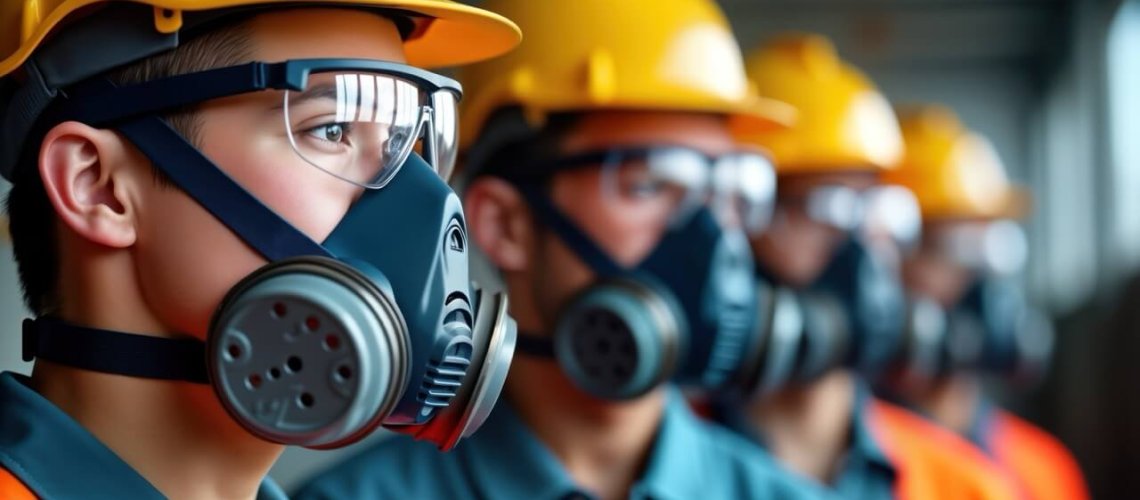

Breathing clean air is fundamental to workplace safety, yet numerous occupational settings expose workers to airborne hazards that can compromise worker health. Understanding and implementing proper respiratory protection requirements is not just a regulatory obligation but a critical component of safeguarding employee well-being. This guide explores essential aspects of respiratory protection programs, helping employers navigate compliance while ensuring workers remain protected from harmful airborne contaminants.
Cal/OSHA has published a workplace safety and health guide titled “Respiratory Protection in the Workplace – A Guide for Employers,” which is meant to supplement the Cal/OSHA Respiratory Protection standard found at Title 8 CCR 5144.
Understanding Respiratory Hazards in the Workplace
Respiratory hazards manifest in various forms across different work environments and typically include particulates, gases, vapors, and oxygen-deficient atmospheres that can potentially harm workers’ respiratory systems. Particulates include dust, fumes, mists, fibers, and smoke, while gases and vapors might originate from solvents, other chemicals, or industrial processes.
When evaluating workplace respiratory hazards, employers must consider several crucial factors. Employers must identify all potential airborne contaminants present in the work environment, determine their concentration levels relative to established exposure limits, and assess the physical state of these substances—whether they exist as solids, liquids, gases, or combinations thereof. Understanding particle sizes for solid contaminants is particularly important, as smaller particles can penetrate deeper into the respiratory system.
Environmental conditions also significantly impact respiratory hazards. Factors such as ambient temperature, humidity levels, process temperatures, and ventilation systems can all influence how airborne contaminants behave and affect workers. For instance, higher temperatures might increase the volatility of certain chemicals, while inadequate ventilation could allow contaminants to accumulate to dangerous levels.
Accurate assessment of respiratory hazards typically requires specialized monitoring techniques; breathing zone air monitoring represents the most reliable method for evaluating employee exposure to airborne contaminants. This approach involves workers wearing personal air sampling devices, including sampling pumps connected to filters or passive monitors, that collect air samples from their breathing zone, which is the area immediately surrounding the head and shoulders. These samples are sent to an industrial hygiene laboratory to be analyzed to determine the airborne contaminant concentrations, providing crucial data for respiratory protection decisions.
Determining When Respirators Are Necessary
Respirators become necessary when workers face harmful exposures that cannot be adequately controlled through other means, like engineering or administrative controls. A harmful exposure occurs when airborne contaminants exceed exposure limits, including Action Levels and Permissible Exposure Limits, established by regulatory standards when they present a reasonable probability of causing injury, illness, or impairment. Oxygen-deficient atmospheres containing less than 19.5% oxygen or those atmospheres considered immediately dangerous to life or health (IDLH) also necessitate respiratory protection.
Before implementing respirator use, employers must follow a hierarchy of controls to minimize exposures. This hierarchy prioritizes elimination or substitution of hazardous materials, followed by engineering controls such as ventilation systems or process enclosures. Administrative controls, including work schedule adjustments and modified work practices, represent the next tier of protection. Respirators should be considered only when these higher-level controls prove insufficient, while they’re being implemented, or if they have been determined not to be feasible.
Several specific circumstances mandate respirator use. These include situations where engineering and administrative controls cannot reduce exposures below established limits, during the implementation of control measures, and reasonably foreseeable emergencies. Additionally, certain substance-specific regulations may require respirator use regardless of exposure levels.
Voluntary respirator use presents another scenario worth considering. Employers may permit workers to use respirators voluntarily when exposures don’t exceed regulatory limits, but workers desire additional protection. In such cases, employers must ensure the respirator itself doesn’t create a hazard, provide users with information contained in regulatory appendices, and implement appropriate elements of a respiratory protection program.
Types of Respiratory Protection Equipment
Respiratory protection equipment falls into two primary categories: air-purifying respirators (APRs) and atmosphere-supplying respirators (SARs). Each type serves specific purposes and offers varying levels of protection depending on workplace hazards and conditions.
Air-purifying respirators work by filtering contaminants from ambient air before it reaches the wearer’s breathing zone, utilizing filters, cartridges, or canisters designed to remove specific contaminants. APRs include disposable filtering facepiece respirators (commonly called “dust masks”), reusable half-mask or full-face respirators with replaceable filters/cartridges, and powered air-purifying respirators (PAPRs) that use battery-powered blowers to pull air through filters into a hood worn by the PAPR user.
Particulate filters for APRs come in nine classifications based on efficiency level and oil resistance. Efficiency levels include 95% (95), 99% (99), and 99.97% (100) filtration effectiveness. Oil resistance categories comprise non-resistant (N), somewhat resistant (R), and strongly resistant (P). For example, an N95 filter provides 95% filtration efficiency against non-oil-based particulates, while a P100 filter offers 99.97% efficiency against all particulates, including oil-based ones.
Atmosphere-supplying respirators provide clean air from an uncontaminated source rather than filtering ambient air. These include airline respirators, which deliver air through a hose connected to a remote clean air source, and self-contained breathing apparatus (SCBA), which utilize portable air tanks carried by the user. Some models combine both approaches, featuring an airline with an auxiliary SCBA for emergency escape purposes.
Respirators can be further classified as negative-pressure or positive-pressure devices. Negative-pressure respirators require the wearer’s inhalation to draw air through the filtering elements, creating negative pressure inside the facepiece relative to outside. Positive-pressure respirators maintain positive pressure inside the facepiece, reducing the risk of contaminant infiltration if face seal leakage occurs.
Establishing a Written Respiratory Protection Program
A comprehensive written respiratory protection program forms the foundation of effective respiratory protection implementation. This document outlines policies, procedures, and responsibilities for all aspects of respirator use within an organization, and the program must address specific elements required by regulatory standards while tailoring approaches to workplace-specific conditions.
The program should begin by designating a qualified program administrator responsible for overseeing all aspects of respiratory protection. This individual requires sufficient knowledge, training, and experience to effectively manage the program, keep their employees safe, and ensure compliance with applicable regulations. The administrator’s responsibilities include evaluating respiratory hazards, selecting appropriate respirators, coordinating medical evaluations and fit testing, and conducting program evaluations.
Procedures for selecting appropriate respirators constitute another critical program component. These procedures must account for workplace contaminants, their concentrations, and work conditions. Selection criteria should include consideration of assigned protection factors (APFs), maximum use concentrations (MUCs), and respirator limitations. Only NIOSH-certified respirators should be selected, and they must be used in accordance with their certification conditions.
The written program must also establish protocols for medical evaluations, fit testing, proper use, maintenance, and storage of respirators. Additionally, it should outline training requirements, recordkeeping procedures, and methods for evaluating program effectiveness. Regular, at least annual, program reviews and updates ensure continued relevance and effectiveness as workplace conditions evolve.
Medical Evaluation Requirements
Medical evaluations determine whether employees can safely wear respirators without experiencing adverse health effects since respirator use places physiological burdens on wearers, potentially exacerbating underlying health conditions, particularly those affecting the cardiovascular or respiratory systems.
These evaluations must be conducted by a physician or other licensed healthcare professional (PLHCP) before an employee first uses a respirator in the workplace. The evaluation typically begins with a medical questionnaire that gathers information about the employee’s health history and work conditions. In some cases, the PLHCP may require a follow-up examination based on questionnaire responses.
Employers must provide the PLHCP with specific information to facilitate accurate evaluations. This information includes the type and weight of respirator to be used, usage duration and frequency, expected physical work effort, additional protective equipment requirements, and potential temperature and humidity extremes. The PLHCP also needs copies of the written respiratory protection program and applicable regulatory standards.
After completing the evaluation, the PLHCP provides a written recommendation regarding the employee’s ability to use the respirator. This recommendation identifies any usage limitations related to the employee’s medical condition or workplace conditions, indicates whether follow-up evaluations are needed, and confirms that the employee has received a copy of the recommendation. Additional medical evaluations become necessary when employees report relevant medical signs or symptoms, when the PLHCP, supervisor, or program administrator indicates a need for reevaluation, or when workplace conditions change significantly.
Fit Testing Procedures
Fit testing verifies that a tight-fitting respirator forms an adequate seal with the wearer’s face, preventing contaminant leakage into the breathing zone. This testing identifies specific respirator makes, models, styles, and sizes that properly fit individual employees while providing opportunities to check for usage problems and reinforce training.
Initial fit testing must occur before employees first use respirators in the workplace. Additional testing becomes necessary whenever different respirator facepieces are used, at least annually thereafter, and whenever changes in an employee’s physical condition might affect respirator fit. Such changes include facial scarring, dental alterations, cosmetic surgery, or significant weight fluctuations.
Two primary fit testing methods exist, including qualitative fit testing (QLFT) and quantitative fit testing (QNFT). Qualitative testing relies on the wearer’s sensory response to detect facepiece leakage of a test agent with a distinctive taste, smell, or irritant effect. This subjective pass/fail approach can be used for all tight-fitting respirators when used voluntarily or when the required protection factor doesn’t exceed 10.
Quantitative fit testing employs instrumentation to measure actual leakage into the respirator, providing a numerical fit factor that represents the ratio of contaminant concentration outside the respirator to that inside the facepiece. QNFT must be used for mandatory respirator use situations requiring protection factors exceeding 10, such as full-facepiece negative-pressure respirators. Minimum passing fit factors include 100 for half-facepiece respirators and 500 for full-facepiece models.
Proper Respirator Use Guidelines
Proper respirator use encompasses various practices that ensure the respiratory protection equipment functions as intended. These practices include performing seal checks, maintaining appropriate facial hair, addressing eyewear and equipment interference issues, and implementing cartridge/canister change schedules.
Seal checks verify proper respirator positioning and face seal integrity each time a tight-fitting respirator is donned. Both positive-pressure and negative-pressure checks should be performed according to manufacturer instructions or regulatory guidelines. During positive-pressure checks, users exhale gently while blocking the exhalation valve, creating slight positive pressure that should maintain the seal without outward leakage. For negative-pressure checks, users inhale while blocking the intake valves or cartridges, causing the facepiece to slightly collapse when properly sealed.
Facial hair presents a significant concern for tight-fitting respirators, as it prevents proper face-to-facepiece sealing. Employees using such respirators must remain clean-shaven in areas where the respirator contacts the face. Other factors that can compromise seal integrity include facial scarring, missing dentures, and jewelry or headgear that interferes with proper positioning.
For air-purifying respirators with cartridges or canisters, establishing appropriate change schedules is essential. These schedules determine when filtering elements must be replaced before they become saturated and allow contaminant breakthrough. Change schedules should be based on objective information such as workplace contaminant concentrations, environmental conditions, and manufacturer recommendations regarding cartridge service life. Personal exposure monitoring conducted by an industrial hygienist is key in the development of cartridge change schedules.
Maintenance and Care of Respirators
Proper maintenance and care ensure respirators remain effective and hygienic throughout their service life. Comprehensive maintenance programs include cleaning and disinfection, storage, inspection, and repair procedures tailored to specific respirator types and usage patterns.
Cleaning and disinfection should follow manufacturer recommendations or established regulatory protocols. Respirators assigned to individual employees should be cleaned as often as necessary to maintain sanitary conditions. Shared respirators require cleaning and disinfection between users, while emergency-use respirators must be cleaned after each use. The cleaning process typically involves disassembly, washing with mild detergent, disinfecting, rinsing, air drying, reassembly, and inspection.
Proper storage protects respirators from damage, contamination, dust, sunlight, extreme temperatures, excessive moisture, and harmful chemicals. Storage areas should prevent facepiece deformation and filter/cartridge degradation. Emergency respirators require clearly marked storage locations readily accessible to potential users, with storage conditions that comply with manufacturer recommendations.
Regular inspections identify defects or deterioration before respirator use. Inspection elements include checking facepiece integrity, strap elasticity, valve functionality, and filter/cartridge condition. Emergency-use respirators require monthly inspections with documentation of inspection dates, inspector identification, findings, and required remedial actions. A self-contained breathing apparatus demands monthly regulator and warning device checks, with air cylinder pressure maintained at recommended levels.
EHS Analytical Solutions, Inc. can help with all your respiratory protection needs. We evaluate potential hazards to determine if respirators are needed, recommended, or unnecessary. Our Certified Industrial Hygienists (CIHs) support clients by performing exposure monitoring for operations of concern, determining what type of respirators are needed, developing Respiratory Protection Programs, developing and delivering site-specific training, and performing fit testing for all your employees. We will also provide all the documentation that is needed.
Do you want help with your respiratory program? Contact us today for a quote.
Contact us link: https://ehs-local.ddev.site/contact
You can also send an email to adam@ehsanalytical.com or call us at 619-288-3094.
Additional information regarding our industrial hygiene consulting services can be found here. https://ehs-local.ddev.site/industrial-hygiene-san-diego/
We look forward to supporting your company!!